
 English
 Čeština
 Slovenčina
8 Quick Tips to Save Money in the Restaurant Industry
Every restaurant owner faces operational costs—from purchasing ingredients and energy to maintaining equipment and paying staff wages. Although these expenses constitute a significant portion of the budget, many entrepreneurs often monitor them inadequately.
The primary reason is the multitude of other tasks and responsibilities that divert their attention from detailed financial planning. Without careful management of operating costs, resources may be used inefficiently, reducing the profitability of the business.
1. Monitoring and Analyzing Costs
The first step toward optimization is a detailed overview of where and how money is spent. We recommend establishing regular cost monitoring. Some restaurant owners use Excel, while others opt for specialized tools designed for the hospitality industry, such as Dishboard. The advantage of these industry-specific tools is that everything is in one place, all data updates automatically, simplifying your search and saving time. Using modern financial management software can save you time and reveal areas with the highest expenses.
2. Optimizing Supplier Relationships
Suppliers of ingredients represent one of the largest expenses for a restaurant. Ensure you have the best possible terms:
- Price Comparison: Regularly check competitive offers.
- Long-Term Collaboration: Suppliers often offer better prices for larger orders or longer-term contracts.
- Seasonality: Negotiate prices for seasonal products and consider using local farmers who may offer more advantageous solutions.
3. Energy Efficiency
Energy is among the largest operational costs. There are several ways to reduce it:
- Equipment Modernization: Investing in energy-efficient appliances pays off over time.
- Turning Off Unused Equipment: Implement simple rules for staff to turn off unnecessary appliances.
- Renewable Sources: Consider installing solar panels or other eco-friendly technologies.
4. Digitization and Process Automation
Digitization can save not only time but also money. By implementing systems for managing reservations, orders, or inventory, you can minimize errors and reduce labor costs.
5. Increasing Staff Efficiency
Regularly assess your team's productivity:
- Training and Education: Well-trained staff work more efficiently.
- Flexible Scheduling: Optimize shifts based on the number of guests and restaurant utilization.
6. Portion Control and Waste Reduction
Wasting ingredients can unnecessarily increase costs. Implement clear rules for meal preparation, such as "First in, first out," and inventory control. Significant savings can be achieved with properly and automatically calculated food costs.
We have created a separate article on food cost, which is worth reading:
7. Regular Equipment Maintenance
Investing in ongoing maintenance prevents costly repairs and the purchase of new equipment. For example, regular checks of refrigerators, dishwashers, or ventilation systems can reduce energy consumption and extend the lifespan of equipment.
8. Effective Marketing Strategies
Well-thought-out marketing can increase revenue and balance costs. Focus on social media, newsletters, or loyalty programs that help retain regular customers and attract new ones. And most importantly—reviews.
Optimizing operational costs requires time, analysis, and strategic planning. By focusing on this process, you can achieve not only savings but also greater efficiency and long-term sustainability for your business.
Time for digitization: A tool for finance, automation, and data analysis.
At a certain point, especially if you're looking to identify unnecessary expenditures, it's worthwhile to use dedicated tools specifically for restaurant finances.
With these systems, you only need to upload invoices (AI reads them automatically, so you don't have to worry about manual entry), connect your cash register with your bank account, and you'll have a perfect overview of your business's finances. Thanks to automation, everything is calculated automatically.
Dishboard also offers their own accountants. This means you don't have to customize your accounting system for your business or struggle with a complicated Excel file to adapt it to your needs. Tools like Dishboard are connected with partner accountants who specialize in the gastronomy sector and are familiar with how things work — including the tool itself. Instead of setting up a separate tool and then hiring an accountant who has to learn how to use it, you get everything in one package.
At a certain point, especially if you're looking to identify unnecessary expenditures, it's worthwhile to use dedicated tools specifically for restaurant finances.
With these systems, you only need to upload invoices (AI reads them automatically, so you don't have to worry about manual entry), connect your cash register with your bank account, and you'll have a perfect overview of your business's finances. Thanks to automation, everything is calculated automatically.
- All documents are in one place
- P&L and cash flow are always available
- Calculation of all expenses, including food cost
- The system automatically alerts you about invoice due dates
- Bulk invoice payments with a single command
- Generation of payment QR codes — no need to manually enter complex payment details
Dishboard also offers their own accountants. This means you don't have to customize your accounting system for your business or struggle with a complicated Excel file to adapt it to your needs. Tools like Dishboard are connected with partner accountants who specialize in the gastronomy sector and are familiar with how things work — including the tool itself. Instead of setting up a separate tool and then hiring an accountant who has to learn how to use it, you get everything in one package.
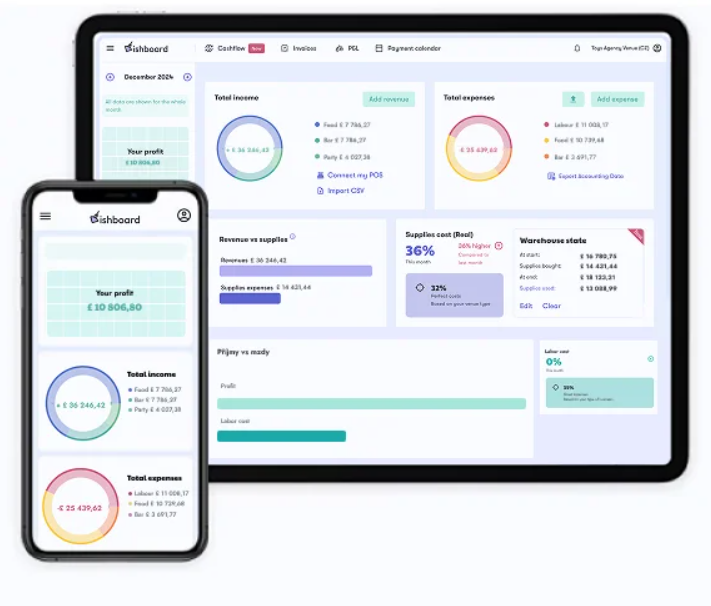
Overview of food cost and other key metrics in Dishboard
Do you want to achieve equally great results in your own hospitality business?
Tell us your story and we’ll create a tailored solution for you!